Cross-Validation
Cross-validation is a resampling technique for estimating model performance. It's essential for model selection, hyperparameter tuning, and getting reliable performance estimates.
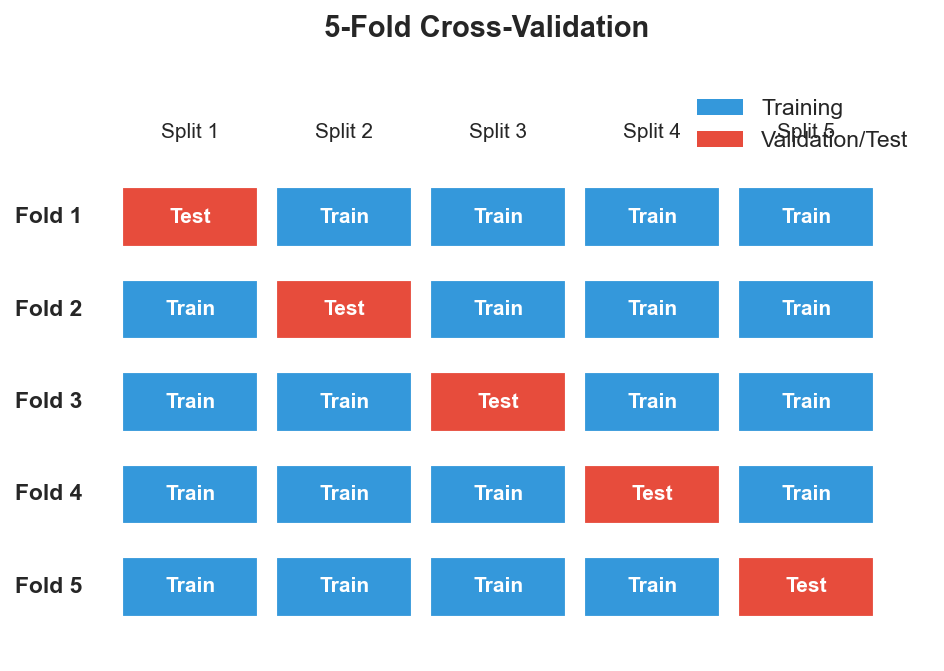
Why Cross-Validation?
The Problem with Train/Test Split
Single split has issues:
- High variance: Different splits give different estimates
- Wastes data: Can't use test data for training
- Lucky/unlucky split: May not represent true distribution
The Solution
Use multiple splits and average:
- More reliable estimates
- Use all data for both training and validation
- Detect overfitting
K-Fold Cross-Validation
The most common approach:
Data: [1, 2, 3, 4, 5, 6, 7, 8, 9, 10]

Fold 1: Train [3-10],    Test [1,2]     → Score 0.85
Fold 2: Train [1,2,5-10], Test [3,4]    → Score 0.82
Fold 3: Train [1-4,7-10], Test [5,6]    → Score 0.87
Fold 4: Train [1-6,9,10], Test [7,8]    → Score 0.84
Fold 5: Train [1-8],     Test [9,10]    → Score 0.86

CV Score: mean = 0.848, std = 0.018
Algorithm
- Shuffle data (usually)
- Split into k equal folds
- For each fold:
- Use 1 fold as validation
- Use k-1 folds as training
- Train model, compute score
- Average scores across folds
Choosing k
| k | Bias | Variance | Computation |
|---|---|---|---|
| Small (3-5) | Higher | Lower | Faster |
| Medium (5-10) | Balanced | Balanced | Moderate |
| Large (>10) | Lower | Higher | Slower |
Standard choice: k=5 or k=10
Leave-One-Out (LOO)
Extreme case: k = n (sample size)
Fold 1: Train on n-1 samples, test on sample 1
Fold 2: Train on n-1 samples, test on sample 2
...
Fold n: Train on n-1 samples, test on sample n
Pros:
- Maximum training data per fold
- Deterministic (no shuffling)
Cons:
- Computationally expensive (n models)
- High variance estimate
- Rarely better than k-fold
Stratified K-Fold
Preserve class distribution in each fold:
Data:  [P, P, P, P, N, N, N, N, N, N]  (40% P, 60% N)

Stratified fold 1: [P, N, N]  (still ~40% P, ~60% N)
Stratified fold 2: [P, N, N]  ...
Essential for:
- Imbalanced classification
- Small datasets
- Multi-class problems
Group K-Fold
Ensure groups don't span train and test:
Patient data: Multiple samples per patient

❌ Wrong: Patient 1 in train AND test → data leakage
✓ Right: Each patient entirely in train OR test
Use when:
- Multiple samples from same source
- Time series from same entity
- Medical data (multiple visits)
Time Series Split
Respect temporal order:
Fold 1: Train [1,2,3],    Test [4]
Fold 2: Train [1,2,3,4],  Test [5]
Fold 3: Train [1,2,3,4,5], Test [6]
Never train on future, test on past!
Nested Cross-Validation
For hyperparameter tuning without bias:
Outer CV (k=5): Estimate generalization
  └─ Inner CV (k=5): Tune hyperparameters

For each outer fold:
    1. Use inner CV to find best hyperparameters
    2. Train with best params on full outer training set
    3. Evaluate on outer test set

Report outer CV scores (unbiased!)
Why nested?
- Single CV for both tuning and evaluation → optimistic bias
- Nested separates model selection from evaluation
Repeated K-Fold
Run k-fold multiple times with different shuffles:
Repeat 1: 5-fold CV → [0.85, 0.82, 0.87, 0.84, 0.86]
Repeat 2: 5-fold CV → [0.84, 0.86, 0.83, 0.85, 0.87]
Repeat 3: 5-fold CV → [0.86, 0.84, 0.85, 0.83, 0.86]

Final: mean ± std of all 15 scores
Reduces variance of estimate.
Cross-Validation Pitfalls
1. Data Leakage
Wrong:
# Scale before split → leakage!
X_scaled = scaler.fit_transform(X)
cv_scores = cross_val_score(model, X_scaled, y)
Right:
# Use pipeline → scaling inside CV
pipeline = Pipeline([
    ('scaler', StandardScaler()),
    ('model', LogisticRegression())
])
cv_scores = cross_val_score(pipeline, X, y)
2. Feature Selection Leakage
Wrong:
# Select features on all data → leakage!
X_selected = SelectKBest().fit_transform(X, y)
cv_scores = cross_val_score(model, X_selected, y)
Right:
# Include selection in pipeline
pipeline = Pipeline([
    ('select', SelectKBest(k=10)),
    ('model', LogisticRegression())
])
3. Ignoring Groups
If samples are correlated (same patient, same session), use GroupKFold.
4. Wrong Metric
Use the same metric you care about:
cross_val_score(model, X, y, scoring='f1')
cross_val_score(model, X, y, scoring='roc_auc')
Practical Usage
from sklearn.model_selection import (
    cross_val_score,
    StratifiedKFold,
    GroupKFold,
    TimeSeriesSplit
)

# Basic k-fold
scores = cross_val_score(model, X, y, cv=5)

# Stratified (default for classifiers)
cv = StratifiedKFold(n_splits=5, shuffle=True, random_state=42)
scores = cross_val_score(model, X, y, cv=cv)

# With groups
cv = GroupKFold(n_splits=5)
scores = cross_val_score(model, X, y, cv=cv, groups=groups)

# Time series
cv = TimeSeriesSplit(n_splits=5)
scores = cross_val_score(model, X, y, cv=cv)
Key Takeaways
- Cross-validation gives reliable performance estimates
- K-fold (k=5 or 10) is the standard approach
- Use stratified k-fold for classification
- Use group k-fold when samples are correlated
- Use time series split for temporal data
- Put all preprocessing inside the CV loop (use pipelines!)
- Nested CV for hyperparameter tuning + evaluation